Let's 🍆 Hump 🍑 on 🪖 Wednesdays

Martinalia is the free weekly dispatch from brother logan, co-creator of Grunt Works. Every week you'll get Fightin' Words, a paraphrase of the Bible I'm building as I work through the Revised Common Lectionary.
You can follow along with the podcast on YouTube and Spotify, or you can get all of it straight from this horse's mouth. Included in every weekly email will be a roundup of what I've published at GI Justice and Pew Pew HQ as well.
⬆️ That's the deal for Martinalia Members. ⬆️
Paying $ubs¢ribers get one more thing: a Wednesday Update. Think of it as writing practice that happens to be about something real — stream of consciousness, half-processed theology, the stuff I'm working through before it becomes a proper essay. Rougher. More personal. Occasionally profane. Always worth it, I think, but you'll have to find out for yourself.
I'm sharing this week's Update with all Members so they can see the polished version of yesterday's "Hump Day" Update. and it's about what soldiers and civilians share when they use the same word to mean completely different things — and why that gap is actually a bridge if you know how to read it.
If you want it, Subscribe. If the free version is enough, that's fine too. Either way, thanks for being here.
This week at GI Justice: NotMyGospel 4: "And Friends" · What OSU Celebrates, and What It Bans
This week at Pew Pew HQ: The Tree of Discernment · GruntGod 2.4.1: What's in a Name?
Hump Day
Civilians know Wednesday as Hump Day — midweek, cresting the hill, closer to the weekend than away from it. The hump is behind you. It's an uplifting noun, a reason to hope.
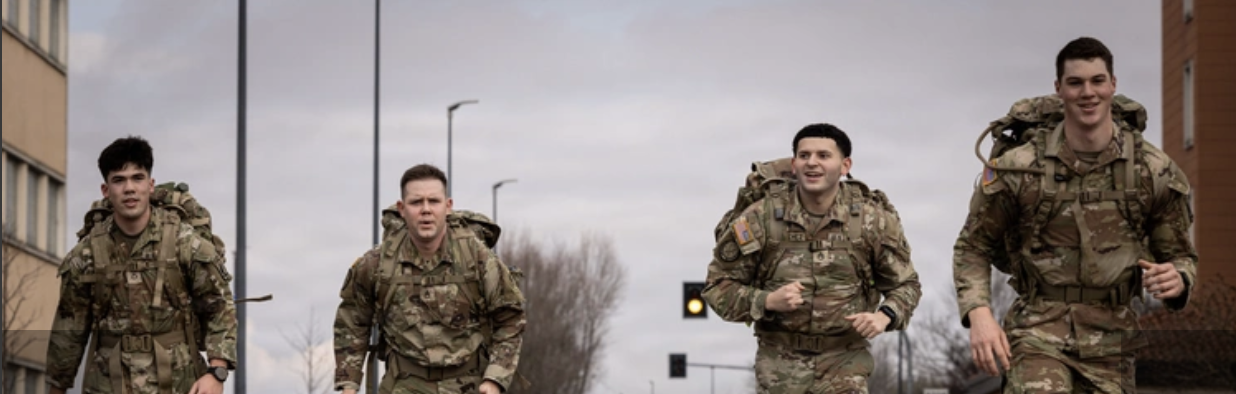
Grunts know it differently. Hump Day means a road march: rucks, inspections, boot-shine, sweat. For light infantry, humping isn't a noun you're past — it's a verb you're stuck inside. The most dreadful of verbs.
And yet there's an unbroken line connecting both meanings, because both cultures share a third one. You know which one. The sexual definition isn't a detour — it's the axis the other two rotate around.
Grammarians would call this parabolic meaning: it bends just enough to unify seeming opposites without breaking the system. That's also what parables do. Depending on your dialect, parabola and parable may even sound the same — and if language is the architecture of consciousness, that's worth sitting with.
The sexual meaning is, at its root, a good one. Physical climax is something we aim toward and achieve. Hump Day borrows that energy: the work is done, now you cool down and rest. Civilians stretch the word just far enough to make Monday through Wednesday bearable.
Soldiers stretch it further, because our work demands it. The soldier's image isn't climax — it's endurance. Dozens of rucks bouncing up and down on grunts. The ruck is doing the humping. If your whole life has been about being on top, a road march will correct that assumption in about four miles.
You either endure the humiliation and do the work, or you become your ruck's subordinate. Everyone watching will know which one you chose.
This is what I've come to think of as moral formation under pressure. The word has to break something to do extra work — same as muscle. You break the weakest link and a stronger one grows back. The goal isn't to avoid being fucked. The goal is to persist through it without becoming a nihilist, to come out the other side knowing what you're made of.
Military culture, at its best, is one of the few things that teaches you to navigate that darkness — not around it, through it — and come back with something useful.